Greenhouse kits
Walk-In Greenhouses
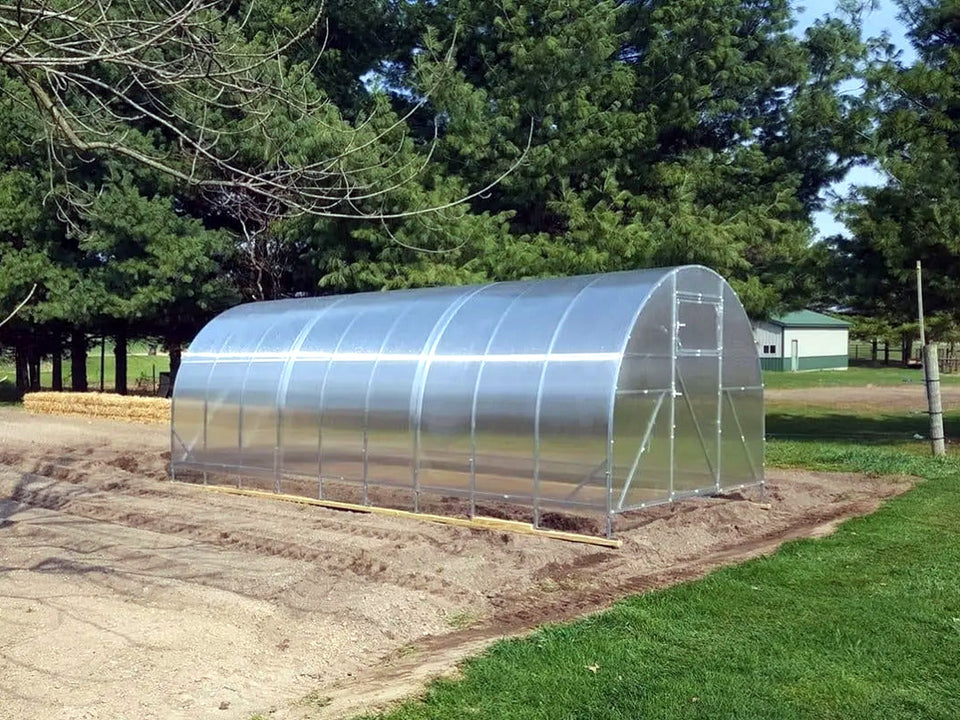
Full standing height, with a Dutch door at each end. Two spans, 8.3 ft and 10 ft, in lengths from 6.5 ft to 65 ft. Every kit is a 1" x 1" hot-dip galvanized steel frame glazed in UV-protected twinwall polycarbonate, from $1,489, with curbside freight to the lower 48 already in the price.
- Free curbside freight to the lower 48
- 1" x 1" hot-dip galvanized steel frame
- 4 mm and 6 mm UV-protected twinwall
- 3-year frame warranty


How these kits are built
Every kit on this page is the same build. The frame is 1" x 1" hot-dip galvanized steel: the zinc is bonded through the wall of the tube rather than coated onto the surface, so the corrosion protection lasts as long as that layer stays intact. It is also the reason a 10 ft walk-in span is affordable at all.
Glazing is UV-protected twinwall polycarbonate in 4 mm or 6 mm. Twinwall traps an air gap between two skins, which is what makes it insulate rather than merely enclose - 4 mm suits season extension in a mild climate, 6 mm is the choice for cold zones, real snow and year-round growing. Both carry a Dutch door at each end, so you can vent the house without opening it up completely.
Hot-dip galvanized steel frame
Every frame here is 1" x 1" hot-dip galvanized steel tubing. Galvanizing bonds zinc through the wall of the tube rather than coating the surface, so the corrosion protection lasts as long as that layer stays intact. Steel is also why a 10 ft walk-in span is affordable at all.
4 mm or 6 mm twinwall polycarbonate
Twinwall traps an air gap between two skins, which is what makes it insulate rather than merely enclose. 4 mm suits season extension in a mild climate; 6 mm is the choice for cold zones, real snow and year-round growing.
Free curbside freight, lower 48
Freight is included in the price rather than added at checkout. Delivery is curbside by LTL carrier to the lower 48 states. Alaska, Hawaii, US territories and PO boxes are quoted separately.
Common questions
What are these greenhouses made of?
A 1" x 1" hot-dip galvanized steel tube frame glazed in UV-protected twinwall polycarbonate, available in 4 mm or 6 mm. Every unit has two Dutch doors, one at each end, so you can vent from the top half without opening the whole doorway.
Should I choose 4 mm or 6 mm panels?
6 mm twinwall insulates better and is noticeably more rigid, which matters if you get hard frosts or real snow load, or if you intend to grow through winter. 4 mm is lighter and cheaper and is enough for season extension in a mild climate. It is the single upgrade worth thinking hardest about.
How much wind and snow will they take?
All three series shed 5 ft of snow. Wind ratings differ by series and we state them individually rather than averaging: 75 mph on the Arc Series, 65 mph on the Loft Series, 65 mph on the Gable Series. Those ratings assume the structure is properly anchored to a prepared base.
Why are the lengths 6.5 ft, 13 ft and 19.5 ft?
The frames are manufactured to metric lengths - 2 m, 4 m, 6 m and up - and we publish the converted figure rather than rounding to a tidier imperial number. A 10 ft x 19.5 ft unit is never listed as a 10x20, because a wrong dimension on a freight order is expensive to unwind.
Do I need a foundation?
You need a level, diagonally square base prepared before the pallet arrives. Compacted gravel, a timber perimeter or a concrete footing all work. What you cannot do is set one of these on unprepared ground - a base out of square makes panels bind and doors sit crooked, and anchoring is what makes the wind rating mean anything.
How does delivery work?
Curbside freight to the lower 48 is included in the price. The unit ships on a pallet by LTL carrier, the carrier calls to book an appointment, and delivery is to the curb rather than to your chosen spot. Inspect the shipment before you sign the delivery receipt - a clean signature is the carrier's evidence that nothing arrived damaged.
What warranty comes with the frame?
A 3-year frame warranty. Full terms, including how polycarbonate panels are treated, are set out on the product page and in our policies.
Will I need a permit?
It depends entirely on where you live. Many jurisdictions exempt small accessory structures below a floor-area threshold, but the threshold varies, and a permanent foundation, electrical supply or plumbing often triggers a permit on its own. Call your local building department before ordering rather than relying on any general figure.