Smaller
Arc 10 ft x 6.5 ft
$1,489$22.91 per sq ft

10ft Straight Wall Walk-In Polycarbonate Greenhouse Kit - Loft Series

Shop Pay Installments is offered at checkout. Shop Pay shows you your own terms before you commit to anything.
Free curbside freight covers the lower 48. Alaska, Hawaii, US territories and PO boxes are excluded - ask us for a quote before you order.
| Wind | Up to 65 mph, this series |
|---|
Every kit carries a 3-year manufacturer warranty on the hot-dip galvanized steel frame against defects in the structure.
Returns: the kit must be unopened and in original condition and packaging, with the polycarbonate undamaged. Return freight is paid by the customer and is deducted from the refund.
Damage in transit is a freight claim rather than a return. Note it on the delivery receipt before you sign, photograph it while the truck is there, and call us the same day.
The standard panel. A thinner wall passes slightly more light, which counts when you are starting seedlings in early spring, and it costs less. In exchange it holds less overnight heat and flexes more under load. Choose 4 mm if your winters are mild and you are stretching the season at both ends rather than growing straight through a hard freeze.
A thicker panel means a deeper air gap between the two skins, and the air gap is what insulates - 6 mm holds more overnight heat and its inner face runs warmer, so less condensation drips onto your plants. The sheet is stiffer and deflects less under snow and wind. In exchange it passes a little less light and costs more.
Short version: cold zone, heavy snow, or you plan to heat the greenhouse through winter - take 6 mm, because it pays back in fuel you do not burn. Mild climate and three-season growing - 4 mm is enough, and the difference is better spent on a longer house.
| 10'W × 6.5'L × 7.2'H | 65.0 sq ft · Family garden |
|---|---|
| 10'W × 13'L × 7.2'H | 130 sq ft · Serious grower |
| 10'W × 19.5'L × 7.2'H | 195.0 sq ft · Serious grower |
| 10'W × 26'L × 7.2'H | 260 sq ft · Serious grower |
| 10'W × 32.5'L × 7.2'H | 325.0 sq ft · Serious grower |
| 10'W × 39'L × 7.2'H | 390 sq ft · Serious grower |
| 10'W × 45.5'L × 7.2'H | 455.0 sq ft · Serious grower |
| 10'W × 52'L × 7.2'H | 520 sq ft · Serious grower |
Freight is included in the price. There is no shipping charge at checkout and no invoice afterwards. What you should know is that a greenhouse travels on a pallet with an LTL freight carrier, not in a parcel van, and that delivery works differently.
Free curbside delivery covers the lower 48 states. Alaska, Hawaii, US territories, and PO boxes are not included in that price. We can still ship to Alaska and Hawaii, but the freight is quoted per order - ask us before you buy.
Questions before you order?Get in touch.
Stated in writing by the manufacturer, on the hot-dip galvanized steel frame.
Anything damaged or missing in transit is replaced by the supplier. Photograph the pallet before you sign for it and send us the pictures.
Curbside delivery to the lower 48 is already in the price. Alaska, Hawaii, US territories and PO boxes are excluded - ask us for a quote.
Sizing, foundations, freight, what arrives on the pallet. Ask before you buy rather than after.
What you're buying
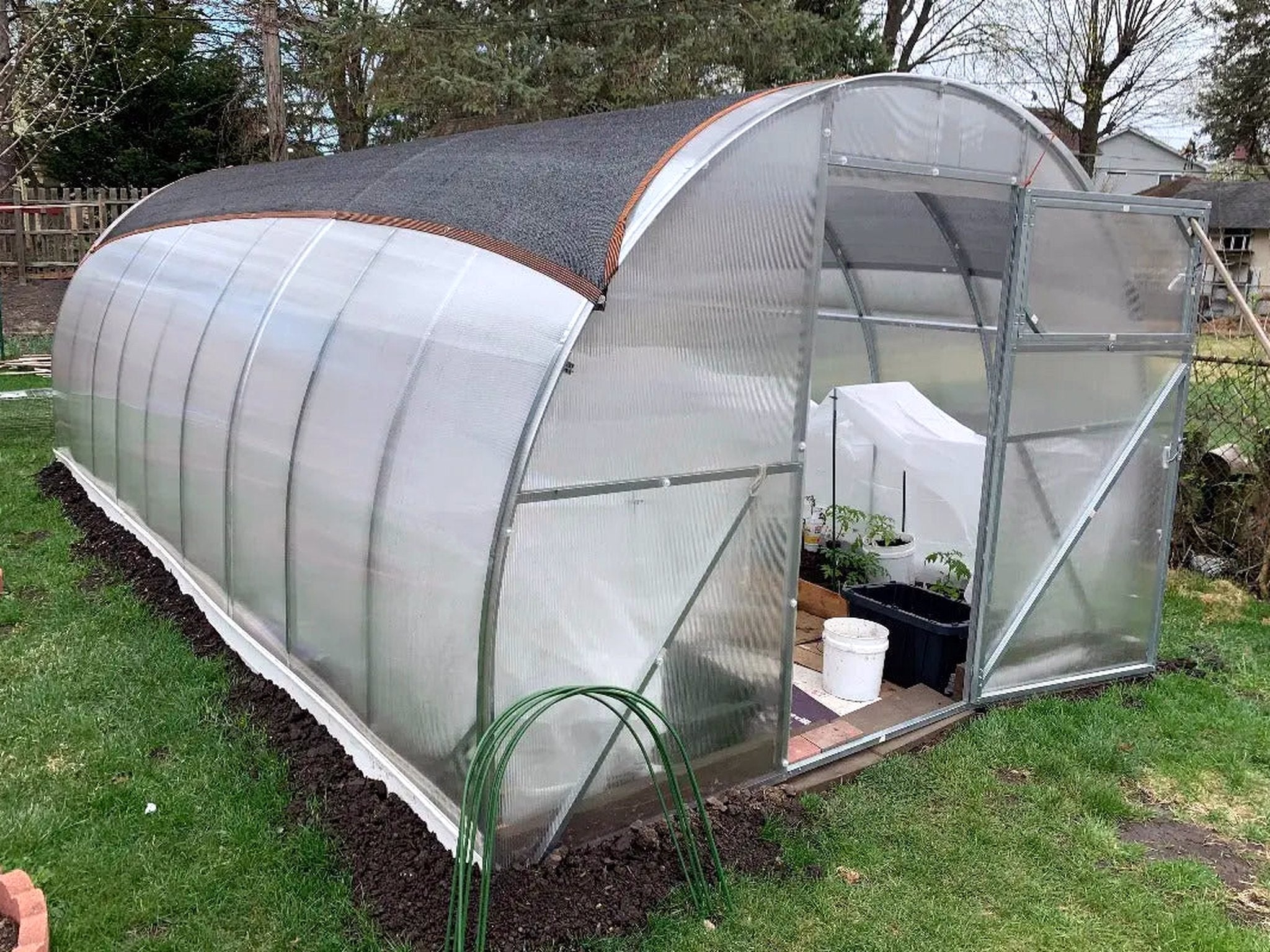
The Loft Series takes the same galvanized steel frame and stands it up: vertical sidewalls to shoulder height, an arched roof over the top, 10 ft wide and 7.2 ft at the peak. That one change gives back the floor an arch loses at its edges. You can stand upright at the wall, run benching the full width, and grow tomatoes in the last foot of the house instead of stacking empty pots there.


Every length below is the real, measured length. Our lengths are metric conversions, so we publish them exactly — a 19.5 ft house is listed as 19.5 ft, never rounded up to 20.
10 ft wide in eight lengths — 6.5 ft (65 sq ft), 13 ft (130), 19.5 ft (195), 26 ft (260), 32.5 ft (325), 39 ft (390), 45.5 ft (455) and 52 ft (520 sq ft).
Straight walls change how the square footage reads. Almost all of it is standing-height floor, so a Loft works harder than the same number on an arch. At 65 sq ft you get a propagation house with a bench down one side. At 130 sq ft two benches and an aisle fit comfortably, which is where most winter growers land. From 260 sq ft up you can heat a zone, hold a cool zone, and still have a packing bench — a large greenhouse by hobby standards, and more than enough to carry a household's vegetables straight through the cold months. And the arithmetic that decides most orders: the price per square foot drops with every length you go up, so the size you nearly bought is almost always the one you should have.

The Loft starts at $1,589 with curbside freight already in the price, and a 10 ft-wide walk-in greenhouse in our line starts at $1,489. The premium 10 ft hobby greenhouses people cross-shop, built on a lighter alloy frame, typically open near $2,400 before delivery is added on. What you are buying here is span: hot-dip galvanized steel is the reason a 10 ft width with vertical walls lands at this number at all.

Both thicknesses are the same UV-protected twinwall polycarbonate — twin-wall, if you have seen it spelled that way. Two sheets are bonded over a sealed hollow channel, and the air trapped in that channel is the insulation. That is why a polycarbonate greenhouse holds heat a single pane of glass gives straight back, and why the light arrives diffused instead of laying a hot stripe across your seedlings. Choosing between the two is a climate question, not a quality one.
The short version: if you intend to grow past the first hard frost, buy the 6 mm. If the house shuts down in November, 4 mm is the honest answer and the difference is better spent on the next length up.


Curbside LTL freight is included in the price for the lower 48 states. Alaska, Hawaii, US territories and PO boxes are not served — contact us for a freight quote outside the lower 48.
Curbside means the carrier brings the pallet to the end of your driveway and it is yours from there, so have a second person and a way to move it. Residential freight is normally delivered by appointment, so keep the phone number on your order current.
Inspect the shipment before you sign the delivery receipt. Note any damage on the receipt at the moment of delivery — that note is what makes a freight claim work, and a signature on a clean receipt is very hard to walk back afterwards.
We do not quote transit times. LTL is a third-party network, and a date we cannot control is not a date worth promising; you get tracking as soon as the shipment is booked.

Undecided between two lengths, or between the two panel thicknesses? Ask us first. We would far rather spend ten minutes on the phone than watch a freight pallet travel back across the country.

Built for the weather
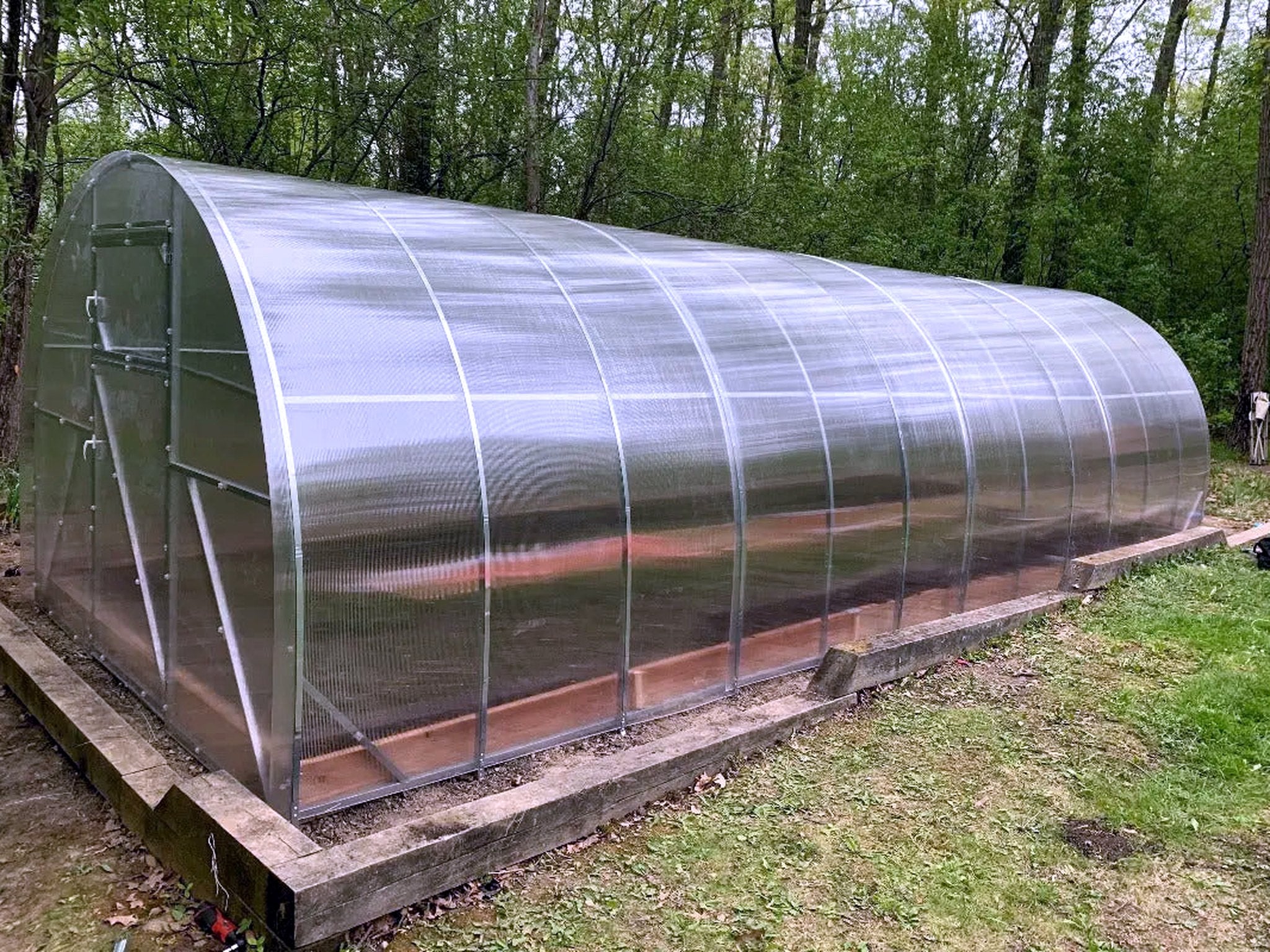
The Arc Series carries a 75 mph wind rating; Loft and Gable are rated 65 mph. All three are 1" x 1" hot-dip galvanized steel under UV-protected twinwall, and all three are shaped to shed up to 5 ft of snow rather than hold it.
Snow shed is a roof profile, not a load rating, and every rating assumes the frame is built to spec and anchored to a level base. Clear the roof after a heavy storm - snow left to drift and pack is what takes greenhouses down.
Before you decide
Same frame, same 3-year warranty, same weekend build - the cost of the ends and the doors just spreads over more floor. On 4 mm Arc the shortest kit works out at $22.91 per sq ft and the longest at $9.06. The extra length is the cheapest growing space we sell.
Smaller
You're viewing
More space
+390 more sq ft than the Arc 10 ft x 26 ft
Square footage is the exact footprint, never rounded to a friendlier number. Arc and Loft are 10 ft wide; Gable is 8.3 ft. Every price includes free curbside delivery to the lower 48.
07 — Questions
Two people, ordinary hand tools and a level base. The frame bolts together section by section and the twinwall panels slide into the frame channels. A longer house is more of the same work rather than harder work.
We do not quote a build time, because it depends on your base, your helpers and the length you ordered, and a number invented here would only make you feel behind. Get the foundation square and level before the pallet arrives and the rest goes the way it is supposed to.
Partly, and the honest answer depends on where you are. Twinwall polycarbonate is two panel walls with a sealed air gap between them, and that gap is the insulation - it is why twinwall holds heat that single-layer glass or film simply loses. Unheated, it runs well above outside temperature on any sunny day and holds a few degrees overnight, which is enough for hardy greens, roots, brassicas and overwintering perennials in milder zones.
Growing tomatoes in January in a cold zone needs supplemental heat, and no greenhouse changes that. Anyone who tells you otherwise is selling you something.
Your kit ships on a pallet by LTL freight, and that freight is included in the price for the lower 48. Curbside means exactly what it says: the carrier brings the pallet to the end of your driveway and stops there. Getting it off the truck's liftgate and up to where you are building is yours to arrange, and a pallet this size wants two people or a machine.
Residential LTL is normally scheduled by a phone call from the carrier, though the scheduling is theirs to run rather than ours. Alaska, Hawaii, US territories and PO boxes fall outside our shipping zone - contact us and we will quote freight separately.
Inspect the shipment before you sign for it. Walk the pallet, look at the panel bundles and the frame boxes, and write anything you find on the delivery receipt while the driver is still standing there. Photograph it too.
This is the single most useful five minutes of the whole purchase. A delivery receipt signed clean is the carrier's evidence that the shipment arrived intact, and it makes a damage claim considerably harder to win afterwards. If the driver is in a hurry, that is not your problem to solve.
Tell us straight away and send photographs of the damage, the packaging it came in, and the delivery receipt showing what you noted at handover. Replacement parts come from the manufacturer, and we handle that conversation for you rather than handing you a phone number.
The claim is far simpler when the damage is written on the receipt, which is the whole reason the question above exists.
A kit can be returned unopened and in original condition, with the polycarbonate undamaged. Return freight is paid by the customer, and on a pallet this size that is a real cost rather than a formality.
We would far rather talk you into the right size before you order than take one back afterwards, which is why the size finder exists and why our phone number is on this page. Call us with your yard dimensions and your climate and we will tell you honestly if the smaller kit is enough.
Something here not covered? Call or write, and we will answer it in writing rather than in a sales call.
A greenhouse ordered now is a greenhouse you are growing in before the last frost. Freight to the lower 48 is already in the price, and the only decision most people stall on is length - so tell us the site and we will tell you the size that fits it.
Get help picking a size